Brooklyn Self
Magan-djin/Brisbane | November 11, 2024
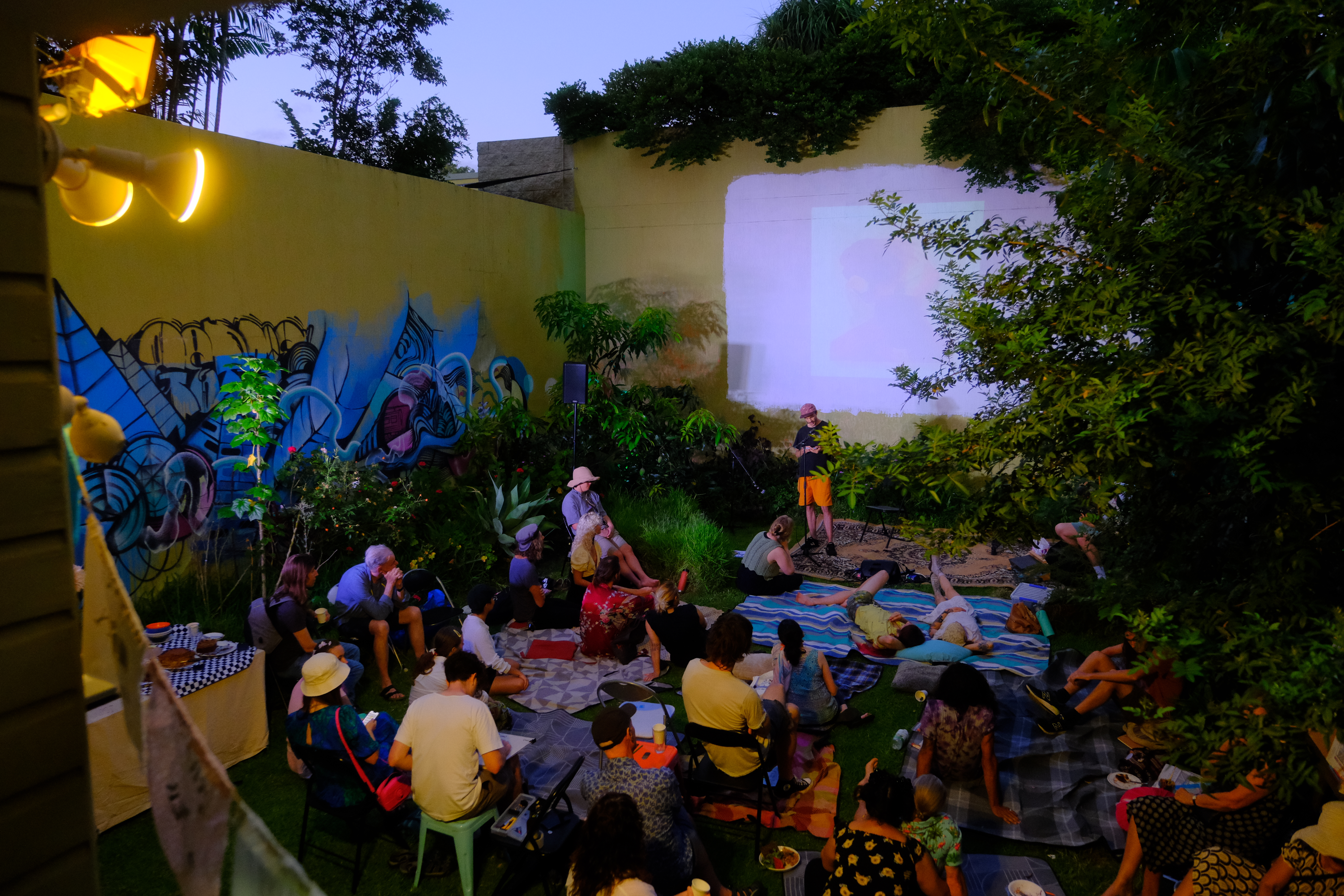
A hidden community lives under a setting sun on a warm Tuesday night. They sit cross-legged or lay sprawled across three picnic mats, eating homemade soup and encased only by yellow walls and the sky itself. I’m happily unsure of where I am as I watch and listen, sharing in the meal and observing vivid conversation.
This is Magan-djin/Brisbane’s Grassroots Action Network – a weekly check in for activists around the city. We turn to a crowded whiteboard that details the meeting’s talking points after we eat. Activists take turns sharing updates from their groups and projects, helping to foster communication, understanding and a united front between members.
It’s a local space to access peers, support and healthy discussion: a place to brainstorm together, organise together, learn together. Am I so far from the politics of our world?
Idiots, callous, and delusional: these are a few of the terms you would see describing activists in Australia’s media. They may be fierce on the frontlines, but they take part in much more than the protests and blockades that make the prime time. Their resistance spans anti-capitalist financial practices, alternative housing and cooking to arts and DIY.
Endless possibility?
To an outsider like me, it’s almost unfathomable not to participate in paid work – or to earn zero annual income. Unrelenting questions amass in my brain like a stack of bricks. How does one feed themselves? Access transportation? Put a roof over their head? Of course, the creature comforts of shopping, entertainment or dining out must be cut quicker than you can say capitalism.
Activist, musician and independent journalist Andy Paine did just that for nearly two years. Andy has been part of disruptive actions across Queensland, including against Adani’s Carmichael coal mine and weapons exhibitions. No stranger to a little controversy, he tells me he’s entirely undaunted about going on the record. I couldn’t smear his reputation any more than existing reports have done, he says.
Andy is primarily concerned with wealth disparity, climate change and our disharmony with the natural environment. He wishes to resist these issues every day by rejecting capital systems.
He says economics have a “coercive” effect on our day-to-day decision making, blinding us from alternative possibilities. Rather than conforming to patterns of work and consumption, Andy has found a method of “living with purpose” through activism.
“I think maybe our lives would be very different if every day we just thought, what’s the most important thing for me to do today?”
Financial resistance
“Anybody who thinks capitalism is a bad idea, or a flawed idea, should really think seriously about how much we’re engaging with it and try to reduce that.
“I think it’s actually probably the best method of everyday resistance we have to capitalism, just refusing to engage in it,” Andy says.

Ralph Waldo Emerson once described capitalism as a system where “doing well is the result of doing good”. That is, it should reward effort, ambition and innovation with liberty – an equaliser and motivator for us all. However, global disparity, exploitation and corruption are a few of the evils lurking on the dark side of this very coin.
Human rights organisation Walk Free reported Australia imports US$17.4 (A$25.6) billion worth of products at-risk of being made using forced labour annually in their 2023 Global Slavery Index. Likewise, Australia’s mass fossil fuel industry continues to elicit a chorus of condemnation from our Pacific neighbours.
If money makes the world go round, some activists are trying to stop it.
Alex* and Morgan* are two full-time activists residing in Meanjin. Like Andy, they currently choose not to participate in paid work, freeing their time to pursue activism in its fullest extent. They dumpster dive, shop frugally, live in shared rooms or flats and access Centrelink payments to enable this choice.
* Names have been changed for privacy protection.
Alex says they gradually began to see the world as a “huge machine”, profoundly affecting the environment and our lives.
“I couldn’t find any way to ethically participate in it,” they say.
“I made a decision to commit my labour and my life’s energy into slowing down and preventing the machine from moving as much as possible, rather than participating in it.”
I felt I’d finally grasped the notion of full-time activism – living with less, being frugal and freeing up valuable time – when I had to do a double take. Despite not having a permanent income, Alex and Morgan both described the financial security they felt living as part of the activist community.
“The way I hear [other] people talking, they sound much more financially stressed than us,” Alex says.
“When push comes to shove, the community can generally find enough money to help people out of situations.
“I feel like I have heaps of economic security because of the stronger relationships.”
Solidarity, not charity
This perceived financial stability is possible thanks to the popularity of mutual aid in leftist activist spaces. Mutual aid is a system of reciprocal cooperation to meet the needs of local community members. It might appear as simple food-sharing, person-to-person financial aid, shared childcare responsibilities or community gardens, but it stems from deep roots in anarchist philosophy.
This system is formulated on the belief that cooperation is essential to human life, in contrast with the ‘survival of the fittest’-style rhetoric that pervades an individualistic society under capitalism. Mutual aid focuses on decentralised, neighbourly solidarity – or a collective, ‘bottom-up’ approach to change. In following a grassroots model, it can evade the bureaucratic red tape, salaries and donors innate to charities and provide more immediate, transparent funding solutions.

Several activists and organisations around Magan-djin practise mutual aid. One of these is the Meanjin Solidarity Fund (MSF): a grassroots organisation that provides funding and resources to local activist groups and individuals in need.
It welcomes varying applications for funds, from art and banner-making supplies to activists requiring legal support or vulnerable community members. It operates via a system of local participatory democracy, where each of its contributing members gets a say in the allocation of funds by voting on proposals and attending meetings.
Morgan says it plays a fundamental role in maintaining the activist community.
“Groups like MSF are incredibly important for the Meanjin leftist space to be running,” they say.
Unmistakably, the majority of activists or rally attendees do participate in paid work. However, they may prefer contributing to a grassroots organisation like MSF than a more structured charity or non-profit operation. Morgan says they all play a significant role in filling the financial gap that full-time activists cannot.
“There is definitely quite a lot of people whose only capacity is to donate to mutual aid,” they say.
“That’s incredibly important because people who do it more full time, in more of a practical, physical sense, don’t always have the additional money to give to other people – or even for themselves.
“The fact there is this solidarity culture that exists is very good.”
The hard-line refusal of capital systems is important to some – but resistance manifests in various ways. Sociocultural anthropologist and ethnographer Dr Elise Imray Papineau has completed several specialised research projects on grassroots activism in Magan-djin and abroad. She says it is difficult to “completely commit” to a permanent lifestyle of economic resistance.
“I think we need to leave space in grassroots structures to be accepting and gentle with people who are just starting to have that shift, and not to be too harsh on people who have lived for decades in a capitalist mindset, who are maybe trying to contend with that.
“It is really hard to think about, you know, ‘I’m going to live off Centrelink and I’m going to live off the grid’…in practice, it’s really hard to absolve yourself or to shut capitalism out of your life,” she says.
However, there are many practical and creative avenues for people to contribute to activist movements and resistant lifestyles.
“I think that’s where the DIY aspect really comes into play,” Dr Imray Papineau says.
Do-it-ourselves

By now, you can likely perceive that grassroots activism is seldom lavish or glamorous in nature. That’s because its amateur, bottom-up approach falls in stark opposition to opulence – rather, it aligns with the resourcefulness and informality of do-it-yourself (DIY) culture.
DIY activism can look like community fridges, zine-making, pop-up free stores, skill-sharing workshops, guerrilla gardening and ‘craftivism’.
In an article for the Journal of Sociology investigating Magan-djin’s activist scene, Dr Imray Papineau found that DIY is a “core characteristic of creative resistance and grassroots organising”. She says it has become a meaningful exercise in self-sufficiency, local interdependence and breaking away from standard models of production and distribution.
“I think you see people, in their resistance towards capitalism and the status quo, trying to reclaim a sense of empowerment and autonomy and saying, ‘I can do this and I don’t need to rely on these systems to do it for me’,” Dr Imray Papineau says.
“Or maybe not, ‘I can do it just myself as an individual’ – but ‘me and my community can do it’.”
In this vein, DIY is closely tied with prefigurative politics: the idea that embodying alternative values in the present is a valuable step towards their future proliferation.
This concept shines through in blockade camps like Camp Binbee where activists protested against Adani’s Carmichael coal mine near Bowen, Queensland. In a video showing its set-up and management, one participant explains how the collaboration of the camp was inspiring.
“This is a community of people working towards a common goal, and that in itself is incredibly empowering,” Will says.
Morgan has participated in multiple camps, adding that they strive to embody the non-hierarchical, supportive organising techniques that are central to do-it-ourselves culture.
“A lot of it is by-consensus organising most of the time, or the people that are on the ground are making decisions,” they say.
“It’s kind of like local direct democracy, but happening very quickly on a small scale.”
The participatory system doesn’t stand in the way of things getting done. Camps operate with the effective use of work rosters and behavioural agreements, to sustain a conducive environment where all participants are on the same page. There are opportunities to contribute to cooking, cleaning, gardening, and media relations, to name a few.
These resistant values and practices are not exclusive to camps – they are harnessed in everyday organisations, including in major cities.

On a suburban corner in Moorooka lies the Fleurs Street Social Exchange. Jacaranda petals carpet the ground in a vibrant purple through spring, beckoning in locals for a visit. The hub encompasses a kitchen and café, a shop, garden, and space to facilitate community workshops.
An environment as quaint as this one seems worlds away from the teeming streets upon which activists march. They have more in common than you’d think.
Fleurs Street refuses to concede to cost-of-living pressures or the loneliness epidemic, instead finding creative, anarchist ways to solve problems and build community. It runs on a pay as you can model and accepts donations from local small businesses, community members or anyone who can spare some extra groceries or second-hand goods.
Volunteer Annika Anycar says the unique community space itself is a vessel to share ideas of resistance.
“In the sense that you’re creating a community of resilience, connections, food and educating people about a better way to live, there’s this kind of role the space has that’s about teaching people about anti-capitalism,” she says.
Every now and then, the exchange offers skill-sharing workshops – a hallmark of DIY activism culture where unique skills can be shared horizontally for the benefit of the community. These have included foraging, weaving, dance and crochet.
Annika says visitors have plenty of “freedom” in the ways they might wish to contribute. (If you are the mysterious visitor who once offered to bring ponies to the exchange – Annika would love to hear from you).
“We want to value people’s contributions from lots of different parts of the community.”
“Like if people say, ‘I’m really good at a grant application’, I would say yes. ‘I’m really good at making posters’. ‘I’m great at bonsai trees’. ‘I could do a workshop’.
“We’re very welcoming of anyone who wants to come and pursue anything.”
It mightn’t be the most dramatic show of protest, but Fleurs Street offers a valuable means to introduce resistance to everyday people in our everyday lives. Annika says it’s “baby steps” towards participating in more direct action.
“I think for some people they live their normal lives and then this is like a taste of activism,” she says.
By building alternative models like Fleurs Street, activists can defy social norms, structures and patterns they don’t believe in.
Food, garbage and sustainability: dumpster diving
Australia wastes 7.6 million tonnes of food, or $36.6 billion, each year. According to Foodbank, it’s enough to feed everyone three times over. Many activists condemn this food waste and use an unorthodox though classic method to counter it: dumpster diving.
Dumpster diving isn’t always conceptualised as an act of resistance. At its heart, it’s a frugal way for people to find food. But beyond the practical outcomes, Dr Imray Papineau says it’s a guerilla method of sustainability.
“We do that because we believe in a world where we don’t have this massive food waste, and where we’re able to feed people and where no one has to be without food.
“We can show people how to do it so they can do it themselves, and that’s a reflection of the world we want to see. So, it’s also prefigurative politics in that sense,” she says.
The activists I documented found $407 worth of food in a haul they describe as “massive”. Click here to see the calculation.
It’s not just money saved from their shallow pockets, but quality, nourishing food saved from a fate in landfill.

Creativity and culture
The DIY ethos extends to cultural production – inspiring the creation of meaningful art and media. Aboriginal artist Richard Bell once described himself as “an activist masquerading as an artist”, reflecting the cultural reach art can have across our society.
Designer and artist Sirena Varma was always creative, but she began to express more of her natural creativity when migrated from Lebanon to Australia. Illustrating landscapes from home helped her feel a sense of reconnection. She says her practice has only transformed further since war escalated in the Middle East in 2023.
“It became a tool for me to process,” she says.
“When something so big happens, you don’t have the words, and it was so helpful for me to just understand what was happening.
“Artists are always on the forefront of depicting what’s happening at the time, and that always involves politics and speaking out.”
Her recent illustration Tears that Water the Land was an artistic though heavy-hearted expression of grief for the bombings and destruction of Lebanon. Sirena found it fostered connection and support online when she posted it to her Instagram, especially among the Lebanese diaspora.
“It’s a symbolic way of thinking, how can I, as someone who lives far away, water the land of back home?” she says.
“It was another piece that resonated a lot with people.”
Sirena offers up her skills and creativity beyond the individual context, founding Magan-djin Creatives for Palestine this year. The group’s 12 Months of Solidarity exhibit brought together photographers, musicians, politicians and creatives to commemorate the documentation of the pro-Palestinian cause in Magan-djin.
The photographs were curated around seven Arabic words connected to the theme of solidarity. One of these, at-takātof (التَكاتُف(, literally means shoulder to shoulder, which was reflected in the exhibit itself.
“It sparks this imagery of like people standing next to each other,” Sirena says.
“All these people turned up – it gives me goosebumps because that’s literally what [solidarity] is.”


The perfect world?
In accordance with their core values, activist groups are expected to be progressive, inclusive spaces. This isn’t always the case.
Compositionally, Magan-djin’s activist spaces are dominated by white, middle-class settlers. This is no unique phenomenon: it has been reported and observed in movements across the Western world.
Insurgent human rights journalist Nick Chesterfield says this stems from the fact most people start engaging with activism as university students in urban areas – two big marks of privilege. He says the audience can often be “bourgeois”.
A sense of tension and discomfort can arise from this dissonance. At worst, Nick says it evokes concepts of white guilt, saviourism, or even the “glorification” of activism and voluntary poverty without truly having skin in the game.
“They want to be the heroic freedom fighter and stuff like that…it’s all very white saviour.”
This egotism can push people away from the movement and has impacts on mental health via cancel culture and the pressure to be constantly devoted to the movement.
“It comes with a lot of ego where there’s people who are seen as the brains behind things, but they don’t let people in.
“They get hypercritical when you’re trying to be constructively critical.
“If people don’t have downtime, there’s no resilience to recharge – people just get burnt out, spat out and see you later…that’s not how you build a future,” Nick says.
In parallel, the focus on arrest as a protest tactic can be polarising because it is only viable for particular types of people.
“It’s only white people, only middle-class people, only people who can afford to go without, who have secure housing, who don’t have a landlord trawling through their social media, who don’t have negative experiences of incarceration,” he says.
The irony of voluntary arrest becomes especially true considering the lived reality of colonialism in Australia, including historical and ongoing police brutality, incarceration, homelessness and sexual violence.
Nick says groups like the Warriors of the Aboriginal Resistance and pro-Palestinian campaigns have effectively implemented Aboriginal leadership but others need to improve, going beyond performativity or “lip service” towards genuine solidarity.
“You know the old saying, ‘nothing about us without us’,” Nick says.
“It’s actually about doing mutual support to local Aboriginal campaigns, it’s about paying the rent, which means that if blackfellas ask you to support their campaigns, you show up.”
According to Nick, the activist community must encompass broader reaching mutual aid, including food, shelter, transport, disability and social support, and the intersectionality of causes to achieve progress.
“Social movements in this colony have had times where they have coalesced together successfully as a united front, and we can do it,” he says.
“We’re just going to have to get serious about bringing people together and being strategic about how we share our skills and resources.”
Imagining the future
In learning about the activist space, I had to ask the blatant but important question: why does it matter?
Dr Imray Papineau says all activists need their own answer to avoid becoming cynical. It might be simply aligning your actions with your values, or making the changes you can for the world.
“I think it stems ultimately from a sense of care – caring towards the planet, caring towards community, caring towards those that we know and those that we don’t know,” she says.
“Care is a really powerful motivator.”
Whether or not the outcomes are tangible, there is value in community, hope and living out the future you want to see, she says.
“Even if it matters for us.”


Leave a Reply to ErinCancel reply